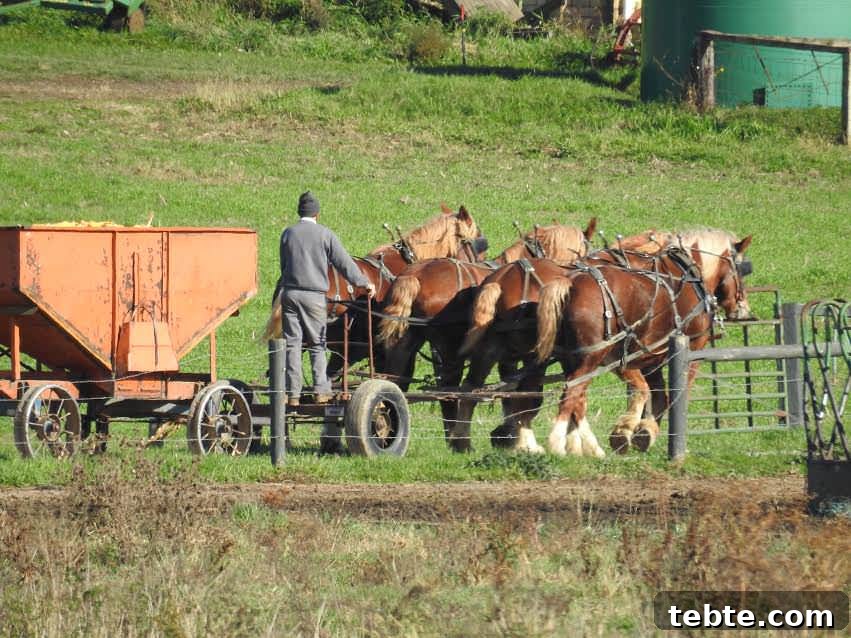
Most Amish in Holmes County, Ohio still farm with horses, but some more progressive groups do use tractors.
By Kevin Williams
A recent photo spread in the British tabloid The Sun described its images as a “rare glimpse” into the Amish, a community often described as reclusive. While photography among the Amish remains less common than in mainstream American life, calling these images entirely rare overstates the case. The Amish regularly interact with their non-Amish neighbors and sometimes participate in film, publishing, and photography projects. Still, the photographs published this week are striking and well composed, offering a vivid look at daily life in Holmes County, Ohio.
Viewing these scenes stirred mixed emotions for me. I have seen many similar moments in person, and some Amish I know are warm, good-natured, and genuinely salt-of-the-earth. The intimate portrait of a man having breakfast alone early in the morning is especially powerful — simple, human, and quietly revealing.
Holmes County is home to a varied array of Plain communities, so pinpointing which subgroup appears in the photographs is not straightforward. My best guess is that these images show members of the New Order Amish Fellowship, sometimes called the New New Order. This subgroup tends to be more accepting of photography compared with more conservative Amish communities. They are a horse-and-buggy group, yet relatively progressive in some ways: certain New Order communities permit tractors for fieldwork and allow limited use of electricity in specific contexts. Looking at the lighting and interior details in the photos, it’s possible some artificial lighting was used, which would be consistent with these more progressive practices.
It was amusing to learn that the photographer assembled the series while covering Rick Santorum’s presidential campaign. Given Amish traditions and their low voter turnout, focusing on courting Amish votes would not be a reliable campaign strategy. The community’s civic habits and views on participation vary, but many Amish historically avoid voting as part of their broader practice of separation from worldly politics.
Regardless of the context in which the photos were taken, they serve as a thoughtful visual record of everyday life in a distinctive American community. The images remind viewers that the Amish are not a monolith: customs and practices vary across settlements, and photography can be welcomed in some groups while discouraged in others. These photographs offer a respectful, humanizing portrayal rather than an exoticized outsider’s caricature, and they invite curiosity about the diverse ways Plain communities balance tradition with selective adaptation.